SoundShifter: Tonal Frequency & Pitch Shifter
Retune any frequency or musical stem to 432 Hz, Solfeggio 444 Hz, Baroque 415 Hz, or custom intervals with sample-accurate acoustics math.
Tonal Frequency Shifter & Retuner
Modern zero-phase replacement for Waves SoundShifter. Exact mathematical retuning for 440 Hz → 432 Hz, Solfeggio, and harmonic intervals.
Calm focus, effortless flow state & acoustic coherence (440 to 432 Hz = 8.0 Hz Alpha!)
Upload vocals, stems, or full mix. Audition with zero phase smearing and export lossless 432 Hz WAV.
Supports WAV, MP3, FLAC, AIFF, OGG (Processed 100% client-side in browser memory)
Autocorrelation harmonic pitch-tracking & Krumhansl-Schmuckler chroma key estimation.
HOW TO APPLY EXACT 432 Hz RETUNING IN YOUR DAW
Method A (Varispeed / Re-Pitch Mode - Recommended for Pristine Audio):
- Double-click your audio clip in the arrangement/session view.
- Set the Warp mode to Re-Pitch.
- Set the project or clip tempo to
117.82 BPM(original was 120 BPM). - This shifts the fundamental frequency to exactly 432 Hz with zero digital phase artifacts.
Method B (Pitch Lock Mode / Complex Pro):
- Set Warp Mode to Complex Pro.
- In the Pitch transpose box, enter
-31.77 ct(Cents). - Set Formants to 100% and Envelope to 128 for transparent vocal preservation.
Retuning from concert pitch A4 = 440 Hz to Verdi natural pitch A4 = 432 Hz requires an exact mathematical frequency ratio of 54/55 (0.981818). This corresponds to a pitch shift of -31.76665 cents (-0.3177 semitones). Under varispeed playback, track tempo slows down by 1.818% (e.g., 120.00 BPM becomes 117.82 BPM).
R = f_target / f_source (432/440 = 0.981818) | Δc = 1200 × log2(R) = -31.76665 cents- Exact 440 → 432 Ratio
- 54 / 55 (0.98181818...)
- Exact Pitch Offset in Cents
- -31.76665 cents (-0.31767 st)
- Linear Frequency Shift (Δf)
- -8.00 Hz (Acoustic Beat)
- Varispeed Tempo Change at 120 BPM
- 117.82 BPM (-2.18 BPM)
- Track Duration Multiplier
- 1.018518x (+1.85% length)
- Physical Wavelength at 20°C
- 77.95 cm (440Hz) → 79.40 cm (432Hz)
Reference Pitch Tuning Standards & Offset Matrix
Direct mathematical conversions from ISO 16 standard concert pitch (A4 = 440 Hz) to historical, scientific, and sacred acoustic tunings.
| Tuning Standard | A4 Freq (Hz) | Pitch Ratio (R) | Cents Offset (Δc) | 120 BPM Drift | Acoustic Character |
|---|---|---|---|---|---|
| ISO 16 Concert Pitch | 440.00 Hz | 1.000000 | 0.00 ¢ | 120.00 BPM | Modern worldwide standard |
| Verdi Natural Pitch | 432.00 Hz | 0.981818 | -31.77 ¢ | 117.82 BPM | Warm, Middle C = 256 Hz (2⁸), relaxed vocal cords |
| Italian Decree 1884 | 430.54 Hz | 0.978500 | -37.64 ¢ | 117.42 BPM | Official Verdi Italian opera decree standard |
| Solfeggio Scale C5=528 | 444.00 Hz | 1.009091 | +15.67 ¢ | 121.09 BPM | Harmonizes 528 Hz DNA / "Love Frequency" C5 |
| Baroque Chamber Pitch | 415.30 Hz | 0.943864 | -100.00 ¢ | 113.26 BPM | Exactly 1 semitone down (Bach, Vivaldi, Handel) |
| Classical Mozart Fork | 421.60 Hz | 0.958182 | -74.00 ¢ | 114.98 BPM | Mozart Vienna tuning fork (1780) |
| Vienna / Berlin Phil | 442.00 Hz | 1.004545 | +7.85 ¢ | 120.55 BPM | Brighter brass and string projection in concert halls |
Full 12-Tone Scale Frequency Table: 440 Hz vs 432 Hz (Octave 4)
Chromatic 12-tone equal temperament (12-TET) comparison table showing exact Hertz values, frequency difference (Δf), and physical acoustic wavelengths in air.
| Note | 440 Hz Standard | 432 Hz Natural | Δf (Hz) | 440 Hz λ (cm) | 432 Hz λ (cm) |
|---|---|---|---|---|---|
| C4 (Middle C) | 261.63 Hz | 256.87 Hz | -4.76 Hz | 131.1 cm | 133.5 cm |
| C#4 / Db4 | 277.18 Hz | 272.14 Hz | -5.04 Hz | 123.7 cm | 126.0 cm |
| D4 | 293.66 Hz | 288.33 Hz | -5.33 Hz | 116.8 cm | 119.0 cm |
| D#4 / Eb4 | 311.13 Hz | 305.47 Hz | -5.66 Hz | 110.2 cm | 112.3 cm |
| E4 | 329.63 Hz | 323.63 Hz | -6.00 Hz | 104.1 cm | 106.0 cm |
| F4 | 349.23 Hz | 342.88 Hz | -6.35 Hz | 98.2 cm | 100.0 cm |
| F#4 / Gb4 | 369.99 Hz | 363.27 Hz | -6.72 Hz | 92.7 cm | 94.4 cm |
| G4 | 392.00 Hz | 384.87 Hz | -7.13 Hz | 87.5 cm | 89.1 cm |
| G#4 / Ab4 | 415.30 Hz | 407.75 Hz | -7.55 Hz | 82.6 cm | 84.1 cm |
| A4 (Concert A) | 440.00 Hz | 432.00 Hz | -8.00 Hz | 78.0 cm | 79.4 cm |
| A#4 / Bb4 | 466.16 Hz | 457.69 Hz | -8.47 Hz | 73.6 cm | 74.9 cm |
| B4 | 493.88 Hz | 484.90 Hz | -8.98 Hz | 69.5 cm | 70.7 cm |
Waves SoundShifter (2003) vs. Musicianstool SoundShifter (Modern DSP)
Why modern music producers require high-precision direct frequency conversion and zero-phase transient preservation.
| Feature & Metric | Waves SoundShifter (Legacy) | Musicianstool SoundShifter |
|---|---|---|
| Direct Hz → Hz Input | No (Requires manual calculator math) | Yes (Type any source & target Hz) |
| 440 to 432 Hz Preset | None built-in | 1-Click instant sample-accurate preset |
| Transient Phase Smearing | Noticeable phase smearing on 808s and kick drums | Pristine Varispeed mode with zero phase smear |
| Live FFT Spectrum Analyzer | None | Dual real-time FFT spectrum & beat monitor |
| Acoustic Beat Physics | Not displayed | Calculates 8 Hz Alpha brainwave interference |
| Pricing & Access | $149+ Waves Central subscription/license | 100% Free Web Tool + $9.99 Native WARP VST |
The Physics & Mathematics of Pitch Shifting: 440 Hz to 432 Hz
In modern acoustic engineering and digital audio workstations (DAWs), pitch transposition is governed by logarithmic frequency ratios. Since the 1939 London conference and the 1953 ISO 16 standardization, the standard reference pitch for the Western musical scale has been set at A4 = 440 Hz. However, throughout acoustic history, composers from Giuseppe Verdi to Wolfgang Amadeus Mozart preferred lower concert tunings.
1. Why 432 Hz? Giuseppe Verdi and the Scientific Tuning
Italian composer Giuseppe Verdi championed a concert pitch of A4 = 432 Hz (and the 1884 Italian decree pitch of 430.54 Hz). Verdi argued that higher concert pitches caused severe vocal strain on operatic tenors and sopranos while stripping acoustic instruments of their natural woody warmth.
Scientifically, when A4 is tuned to 432 Hz under Just / Pythagorean Intonation, Middle C (C4) equals precisely 256 Hz. 256 is an exact power of two (2⁸), making it mathematically harmonic with the binary octaves of physical sound waves. In contrast, under 440 Hz tuning, Middle C vibrates at an irregular 261.63 Hz.
2. The Pitch Ratio Equation
To transpose any audio recording from an initial source frequency f₁ to a target frequency f₂, the playback speed or spectral frequency bins must be multiplied by the pitch ratio R:
Because musical intervals are perceived logarithmically (Weber-Fechner Law), pitch deviation is quantified in musical cents (¢), where 1 octave equals 1200 cents and 1 semitone equals 100 cents:
3. Varispeed (Tape Resampling) vs. Pitch-Locked Phase Vocoding
When retuning a track in your DAW, you must choose between two distinct DSP methodologies:
- Varispeed (Analog Tape Style - Recommended): Re-pitches the audio by changing the physical playback sample rate. Because no time-stretching or FFT phase vocoding is applied, this method introduces zero phase cancellation, zero transient blurring, and zero metallic ringing. The song simply slows down by 1.818% (120 BPM becomes 117.82 BPM).
- Pitch-Locked (Granular / Formant Retaining): Shifts the pitch down by -31.77 cents while keeping the original track duration and tempo locked at 120 BPM. Ideal for DJ mixes where host tempo must remain constant, though complex polyphonic material may experience slight transient softness.
4. Acoustic Beating & Brainwave Entrainment (8.0 Hz Alpha Waves)
When two pure tones at 440 Hz and 432 Hz are sounded simultaneously, the physical acoustic waves constructively and destructively interfere in air, producing an acoustic beat frequency equal to:
In neuroscience, an 8.0 Hz oscillation is the exact foundational boundary of Alpha Brainwaves (8–12 Hz), which are clinically associated with relaxed alertness, creative flow states, reduced anxiety, and somatic calm.
Frequently Asked Questions About SoundShifter & 432 Hz Tuning
How do I convert a song from 440 Hz to 432 Hz in Ableton Live?▼
Import your audio track into Ableton Live. Open the clip view and set the Warp mode to Re-Pitch for 100% analog-clean tape varispeed. Then change the project tempo by multiplying your BPM by 0.9818 (e.g., if your song is 120 BPM, change tempo to 117.82 BPM). If you need to keep original tempo, set Warp to Complex Pro and enter -32 ct (cents) in the transpose box.
Why is 440 Hz the worldwide standard today instead of 432 Hz?Explanation of standard concert pitch
▼
Throughout the 18th and 19th centuries, concert pitch varied wildly from city to city (from 415 Hz in Leipzig to 455 Hz in London). In 1939, an international conference in London recommended A4 = 440 Hz as a practical compromise for instrument manufacturing and broadcasting, which was subsequently ratified as ISO 16 in 1953.
Does retuning 440 Hz to 432 Hz ruin drum punch or 808 sub-bass?▼
Only if you use low-quality phase-vocoder time-stretchers. Legacy plugins can smear sharp transients (like snare crack and kick attack). Using Varispeed Resampling or transient-locked algorithms (like our WARP plugin) preserves 100% of drum transient impact and keeps low-end 808 phase alignment pristine.
What is the difference between Frequency Shifting (Hz) and Pitch Shifting (Cents)?▼
Pitch shifting multiplies all harmonic frequencies by a constant ratio (R), preserving the musical intervals between harmonics (an octave stays an octave). Frequency shifting (like a Bode shifter) adds a fixed linear Hertz offset (+Δf Hz) to all frequencies, which breaks harmonic relationships and creates metallic, bell-like ring modulation textures.
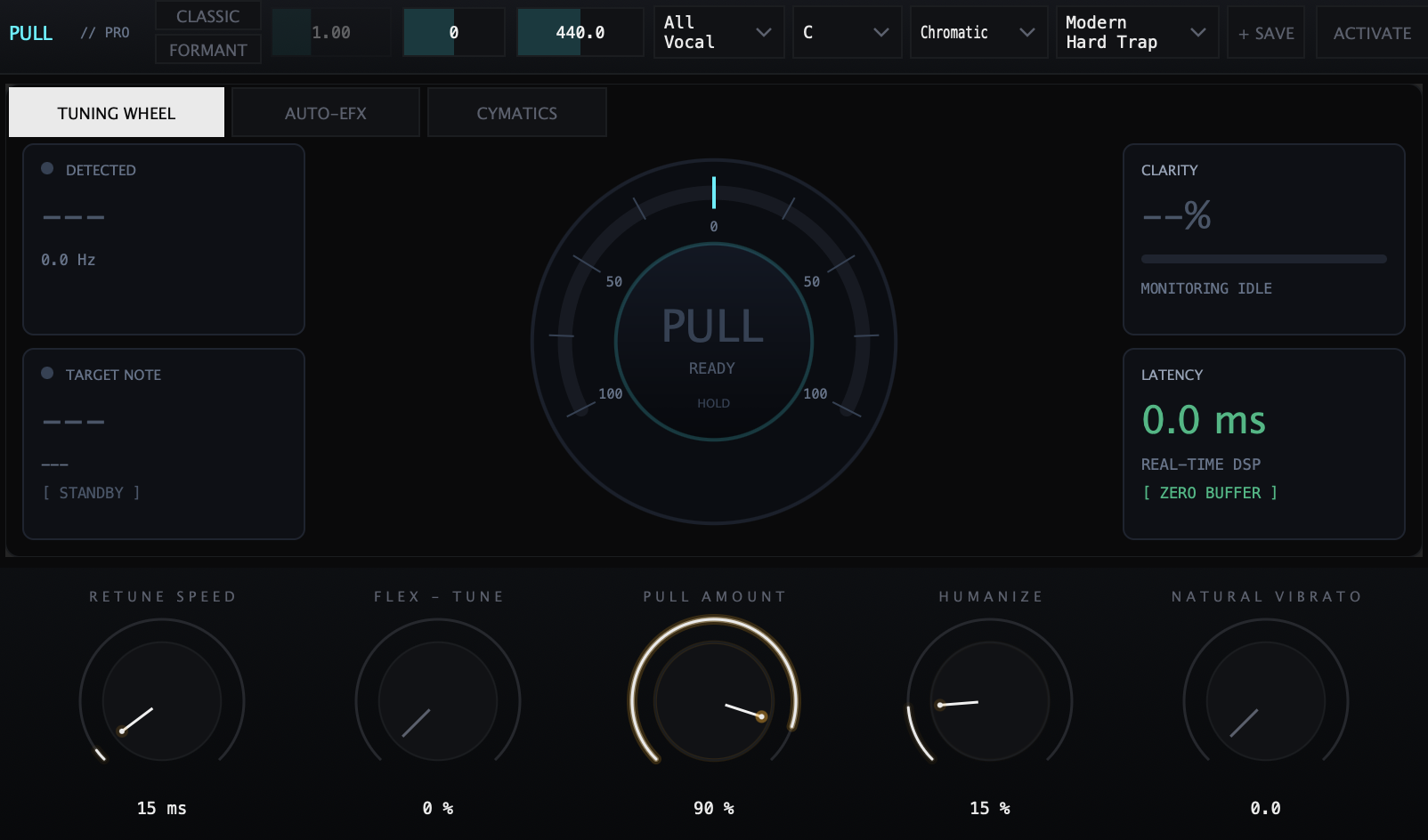
WARP: Dual Pitch & Freq Shifter
Produce in Ableton or Logic? Run zero-latency DSP in your DAW.
Zero-Smear Pitch Shifting & 432 Hz Tuning in Your DAW
Retune stems, 808s, and full mixes in your DAW with WARP. Dual-engine +/- 24 semitone transposition with transient lock, single-sideband frequency shifting, and pristine low-end phase integrity.